Money guide · 6 min read · updated 2026-11-10
How Much to Set Aside for Quarterly Taxes as a Freelancer
When nobody withholds tax from your pay, you have to hold it back yourself. Here’s how estimated taxes work, what the self-employment tax adds, and a simple way to decide how much of each payment to park in a tax account.
This is general information, not tax advice. Tax rules change and your situation will differ. Check with a tax professional and the pages on IRS.gov before you decide what to pay.
Why freelancers pay tax four times a year
An employee has income tax and Social Security and Medicare taxes taken out of every paycheck. A freelancer gets the whole invoice amount, so the IRS expects you to send tax in during the year instead. These payments are called estimated taxes, and they’re made with Form 1040-ES, Estimated Tax for Individuals.
According to the IRS, you generally have to make estimated payments if you expect to owe $1,000 or more in tax when you file your return, after subtracting withholding and refundable credits. Most full-time freelancers clear that bar quickly.
You can pay online through your IRS online account or Direct Pay, by phone, through the IRS app, or by mailing a check with a 1040-ES voucher.
The four due dates (and why they aren’t really quarters)
The IRS splits the year into four payment periods, but they’re uneven. The first covers three months, the second only two, the third three and the last four.
| Income earned | Due for tax year 2026 | Due for tax year 2027 |
|---|---|---|
| Jan 1 – Mar 31 | April 15, 2026 | April 15, 2027 |
| Apr 1 – May 31 | June 15, 2026 | June 15, 2027 |
| Jun 1 – Aug 31 | September 15, 2026 | September 15, 2027 |
| Sep 1 – Dec 31 | January 15, 2027 | January 2028 (see below) |
The 2026 dates come from the 2026 Form 1040-ES. The April, June and September 2027 dates appear in the IRS draft of Publication 509 (2027), Tax Calendars. January 15, 2028 falls on a Saturday, and IRS rules move any due date that lands on a weekend or legal holiday to the next business day. Check the 2027 Form 1040-ES when it’s released for the exact January date.
One more detail from the 2026 form: you don’t have to make the January 15, 2027 payment if you file your 2026 return by February 1, 2027 and pay the full balance with it.
What you’re actually saving for
Your set-aside has to cover two separate taxes.
Self-employment tax
This is Social Security and Medicare for people who work for themselves. The IRS gives the rate as 15.3%: 12.4% for Social Security and 2.9% for Medicare. It applies if your net earnings from self-employment are $400 or more.
It isn’t charged on your full profit. The IRS says the amount subject to self-employment tax is generally 92.35% of your net earnings, and the 1040-ES worksheet uses the same 0.9235 factor. For 2026, the Social Security part applies only to the first $184,500 of combined wages, tips and net earnings. Above certain income levels an Additional Medicare Tax of 0.9% also applies.
You can deduct the employer-equivalent portion of self-employment tax (half of it) when you work out your adjusted gross income. That lowers your income tax. It doesn’t lower the self-employment tax itself.
Income tax
On top of that you owe ordinary federal income tax on your profit, plus state income tax if your state has one. How much depends on your filing status, deductions, credits, a spouse’s income and more. That’s why no single percentage is right for everyone.
Safe harbor: the rule that limits penalties
If you pay too little by each due date, you can be charged an underpayment penalty even if you get a refund in the end. The IRS says most people avoid the penalty if they owe less than $1,000 after withholding and credits, or if they paid at least the smaller of:
- 90% of the tax for the current year, or
- 100% of the tax shown on last year’s return (the return must cover all 12 months).
The 2026 Form 1040-ES adds that if your adjusted gross income for 2025 was more than $150,000 ($75,000 if married filing separately), you substitute 110% for 100%. Farmers and fishermen have different rules.
The prior-year option is handy in a growing business. Take last year’s total tax, divide by four, and pay that on each date. You may still owe more in April, but you shouldn’t face a penalty for the quarters, which is why the money you set aside still matters.
A rule of thumb for the set-aside
Many freelancers move a fixed share of every payment into savings as it arrives. A figure of 25% to 30% of profit is a common rule of thumb for federal taxes. It’s a starting point, not a calculation. People with low profit may need less. Higher earners and people in high-tax states often need more.
Three habits make the percentage work:
- Apply it to profit, not revenue. Subtract business expenses first, or your set-aside will be too high in heavy-spending months.
- Use a separate savings account. Money in your checking account looks spendable. Money in a labeled tax account doesn’t.
- Move it the day you’re paid. Waiting until the end of the month is how the tax money turns into rent money.
Once you’ve filed a full year, compare what you saved with what you actually owed and adjust the percentage.
Worked example: $60,000 of net profit
This is a simplified illustration. It assumes a single freelancer with no other income and ignores state tax, credits, deductions, the Qualified Business Income deduction and everything else that changes a real tax bill. The point is to show the mechanics, not to estimate anyone’s tax.
Step 1: self-employment tax
| Line | Calculation | Amount |
|---|---|---|
| Net profit | $60,000.00 | |
| Amount subject to SE tax | $60,000 × 0.9235 | $55,410.00 |
| Self-employment tax | $55,410 × 0.153 | $8,477.73 |
| Deductible half (reduces income tax only) | $8,477.73 ÷ 2 | $4,238.87 |
Self-employment tax alone comes to about 14% of profit here, before any income tax.
Step 2: apply a set-aside percentage
| Rule of thumb | Yearly set-aside | Per payment (÷4) | Per month (÷12) | Left for income tax after SE tax |
|---|---|---|---|---|
| 25% of profit | $15,000 | $3,750 | $1,250 | $6,522.27 |
| 30% of profit | $18,000 | $4,500 | $1,500 | $9,522.27 |
Whether the leftover column is enough depends on the income tax this person actually owes, which this illustration doesn’t try to work out.
Step 3: watch the uneven periods
Say the $60,000 comes in evenly at $5,000 a month. Because the payment periods are different lengths, the profit in each one isn’t equal:
| Period | Months | Profit | 30% set aside |
|---|---|---|---|
| Jan – Mar | 3 | $15,000 | $4,500 |
| Apr – May | 2 | $10,000 | $3,000 |
| Jun – Aug | 3 | $15,000 | $4,500 |
| Sep – Dec | 4 | $20,000 | $6,000 |
| Total | 12 | $60,000 | $18,000 |
The June payment is where people get caught. Only two months of income have come in, but the standard method still expects a full quarter of the year’s tax by June 15. Saving monthly rather than per period smooths this out. If your income really is lumpy, the IRS annualized income installment method (Form 2210 and Publication 505) lets payments follow when you earned the money.
Keeping track without a headache
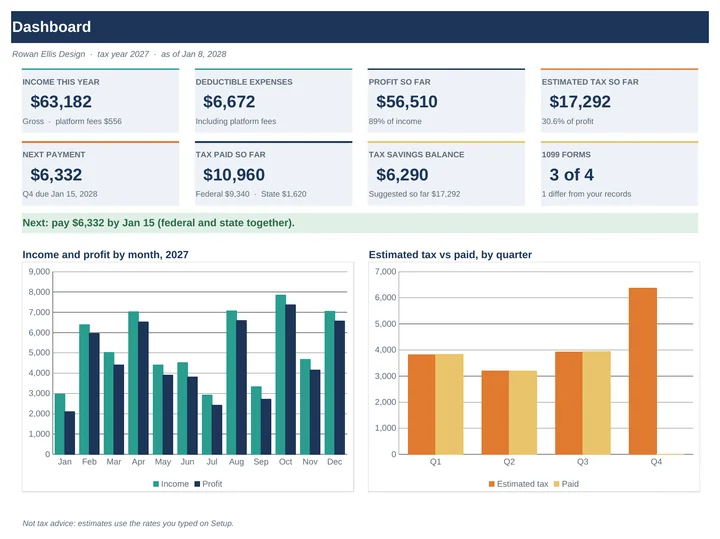
You need three numbers on hand at all times: profit so far in the current period, how much is sitting in the tax account, and what’s due next and when. A spreadsheet works fine. Our Freelancer Quarterly Tax & 1099 Tracker works out profit for each estimated-tax period from your own rates, suggests a monthly set-aside, and keeps a running tax savings balance. The due dates are prefilled from the usual IRS calendar and you can edit them.
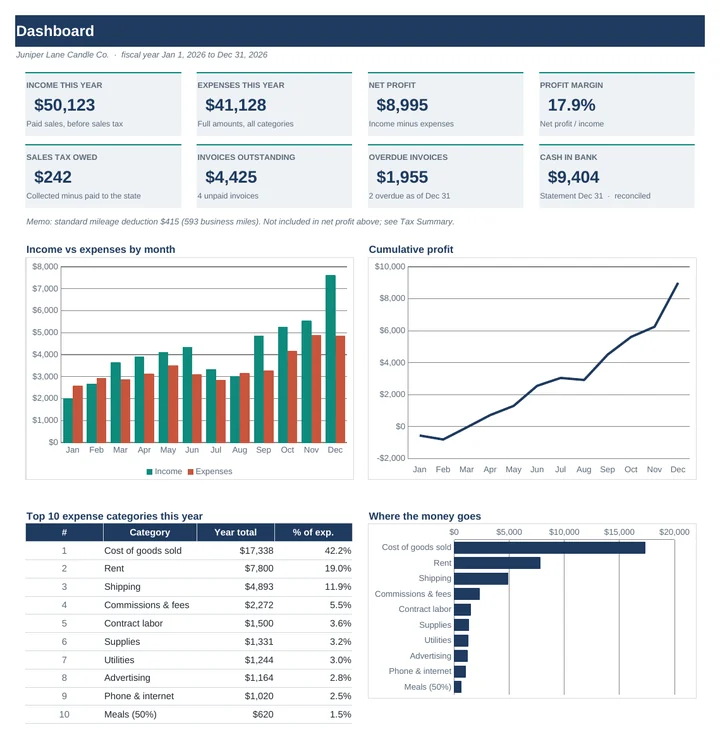
If you also want invoices and a full profit-and-loss view, the small business bookkeeping spreadsheet covers that side. When your income swings from month to month, our guide to budgeting with irregular income pairs well with a tax set-aside.
The short version
- Estimated tax is paid with Form 1040-ES, four times a year, on uneven periods.
- Self-employment tax is 15.3% on 92.35% of net earnings, before income tax.
- Paying 100% of last year’s tax (110% at higher incomes) or 90% of this year’s generally avoids the penalty.
- 25% to 30% of profit is a common starting point for a set-aside. Refine it with your own numbers.
Whatever percentage you choose, write it down and apply it every time you’re paid. If you’d like the sums done for you each period, the quarterly tax tracker is built around exactly this routine.
Sources
- IRS, Estimated taxes
- IRS, Self-employment tax (Social Security and Medicare taxes)
- IRS, Topic no. 554, Self-employment tax
- IRS, Form 1040-ES (2026), Estimated Tax for Individuals
- IRS, About Form 1040-ES
- IRS, FAQ: When are quarterly estimated tax payments due?
- IRS, Publication 509 (2027) draft, Tax Calendars
- IRS, Publication 505, Tax Withholding and Estimated Tax
Spreadsheets for this
 Freelancer Quarterly Tax & 1099 TrackerWhat to set aside, what to pay by each due date, and a check of every 1099.€11.99
 Small Business Bookkeeping & P&LIncome, expenses and invoices in, a monthly profit and loss out. No formulas to write.€11.99
 2027 Budget PlannerPlan the year one paycheck at a time, even when your income changes month to month.€15.99