Money guide · 5 min read · updated 2026-11-10
How to Teach Kids About Money with Chores and Allowance
Kids learn money by handling it: earning a little, choosing what to do with it, and sometimes wishing they’d chosen differently. A simple chore and allowance system gives them that practice every week.
Start earlier than feels necessary
The Consumer Financial Protection Bureau’s Money as You Grow program is built on the idea that it’s never too early, or too late, to talk with children about money. What changes with age is how you talk about it. Its parent activities start at ages 3 to 5, with exercises on stopping to think before spending and imagining life as a “big kid.”
The CFPB also stresses that children pick up your moods and attitudes about money, not just your words. Calm, regular conversations do more than one big lecture.
Ideas by age
Ages 4–6: money is something you choose with
- Use real coins and see-through jars, so they can watch the pile grow.
- Keep chores short and visual: put toys away, feed the pet, set out napkins.
- Pay weekly, on the same day, so the rhythm is predictable.
- Practice small choices: this sticker now, or that toy in two weeks?
Ages 7–9: saving for something specific
- Introduce a named savings goal with a picture and a price.
- Add chores that take real effort, like unloading the dishwasher or sorting laundry.
- Let them count and record their own money.
- The CFPB’s activity for ages 6 to 9 focuses on savings goals, because knowing exactly what you’re saving for makes saving easier.
Ages 10–12: planning and trade-offs
- Hand over a small budget for something real, such as their share of a birthday party or holiday gifts. The CFPB has an activity for ages 7 to 12 on using a budget to shop for a party.
- Track money in a simple ledger or spreadsheet instead of jars only.
- Offer bigger paid jobs, like washing the car or raking leaves.
- Talk through price comparisons in the store.
Paid chores versus family chores
One of the first decisions is whether all chores earn money. Many families split them into two groups.
Family contributions are unpaid. Making your bed, clearing your plate, tidying your room. Everyone in the house does these because they live there, the same way adults don’t get paid to cook dinner.
Extra jobs are paid. These go beyond the basics and look more like work: weeding, washing the car, helping clean out the garage.
The split avoids a common problem. If every task has a price, a child can decide they don’t need money this week and skip everything. Keeping the basics unpaid makes it clear they aren’t optional.
Base allowance, commission or both
There are three common setups:
- Base allowance only. A fixed amount every week, separate from chores. Good for practicing money management without turning chores into a negotiation.
- Commission only. Kids earn per chore or per point. Good for linking effort to money, but income can swing a lot.
- Base plus commission. A small fixed amount plus extra for paid jobs. Many families land here because it gives a steady floor and room to earn more.
A variation: pay the base only if most of the family chores got done that week, for example at least three-quarters of them. Pick one rule, write it on the chart, and stick to it.
Points are useful when chores differ a lot in effort. A quick job might be 1 point and a big one 4, with each point worth a set amount. You can change the point value as kids get older without rewriting the chart.
Save, spend, give
Splitting each payment into three jars or envelopes is a simple way to show that money has more than one job:
- Save for a goal that takes weeks.
- Spend on whatever they choose, within family rules.
- Give to a cause, a friend’s fundraiser or a gift for someone else.
The percentages are up to you. Something like 50% save, 40% spend, 10% give is easy to work with. Younger children often do better with a bigger spend share, so the reward feels real.
Savings goals and time to goal
A goal turns “save” from a vague instruction into a countdown. The maths is simple:
Weeks to goal = (goal price − already saved) ÷ amount saved per week, rounded up.
Round up, not down. If the answer is 7.4 weeks, it takes 8 weeks of saving. Mark the weeks on the chart so they can cross them off.
Worked example: a 9-year-old saving for a $30 toy
Maya is 9. She gets a $3 base allowance each week, and paid chores earn points worth $0.25 each. Each payment is split 50% save, 40% spend, 10% give. Here are her first four weeks:
| Week | Points | Chore pay | Base | Total | Save (50%) | Spend (40%) | Give (10%) |
|---|---|---|---|---|---|---|---|
| 1 | 8 | $2.00 | $3.00 | $5.00 | $2.50 | $2.00 | $0.50 |
| 2 | 10 | $2.50 | $3.00 | $5.50 | $2.75 | $2.20 | $0.55 |
| 3 | 6 | $1.50 | $3.00 | $4.50 | $2.25 | $1.80 | $0.45 |
| 4 | 12 | $3.00 | $3.00 | $6.00 | $3.00 | $2.40 | $0.60 |
| Total | 36 | $9.00 | $12.00 | $21.00 | $10.50 | $8.40 | $2.10 |
After four weeks Maya has $10.50 saved. Her average saving is $10.50 ÷ 4 = $2.625 a week.
- Still needed: $30.00 − $10.50 = $19.50
- Weeks to go: $19.50 ÷ $2.625 = 7.4, so 8 more weeks
- From a standing start, the whole goal takes $30 ÷ $2.625 = 11.4, so 12 weeks
That’s a useful conversation. Twelve weeks is a long time at 9. Maya might decide to do more paid chores, wait, or pick a cheaper toy. All three are good money lessons, and she chose.
Let them make small mistakes
The hardest part for parents is keeping quiet when a child spends their whole spend jar on something you know will break by Tuesday. That disappointment, at $4, is cheap tuition. The same lesson at 25 with a credit card costs a lot more.
A few ground rules help:
- Don’t rescue. If the money’s gone, it’s gone until next payday. No advances on next week.
- Do debrief. Ask, without judgment, whether it was worth it and what they’d do next time.
- Keep the save jar protected. Spending money is theirs to waste. Savings are for the goal.
- Be consistent with pay day. If you forget to pay, you’re teaching that the system isn’t real.
Making it easy to keep going
The systems that work are the ones parents can keep up week after week. A printed chart on the fridge and one place to record points and payments is usually enough.
Our kids chore chart and allowance tracker handles up to four children, with chores counted in points or money, a base allowance paid always or only when a set share of chores is done, a Save/Spend/Give split for each child, and savings goals with weeks to go. It includes printable chore charts by age group (4–6, 7–9 and 10–12).
If you’re also sorting out the household side, the family budget spreadsheet bundle covers that. The holidays are a good time for a gift-budget lesson, and the Christmas budget planner works for that too. For bigger yearly costs, see sinking funds explained.
Start small: one chart, one pay day, three jars. If you’d like the points, splits and weeks-to-goal worked out for you, the chore and allowance tracker does that each week.
Sources
- Consumer Financial Protection Bureau, Money as You Grow: Help for parents and caregivers
- Consumer Financial Protection Bureau, Talking about money choices
- Consumer Financial Protection Bureau, Learn to save with Money Monsters (activity guide)
- Consumer Financial Protection Bureau, Use a budget to shop for a party (activity guide)
Spreadsheets for this
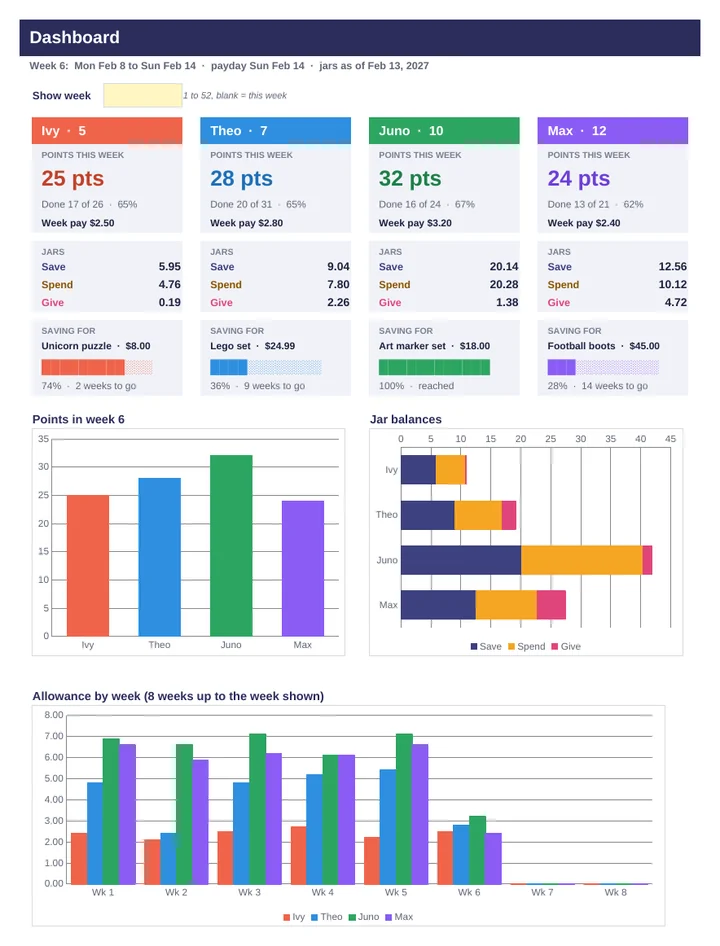 Kids Chore Chart & Allowance TrackerTick off chores, pay the allowance and split it into spend, save and give.€7.99
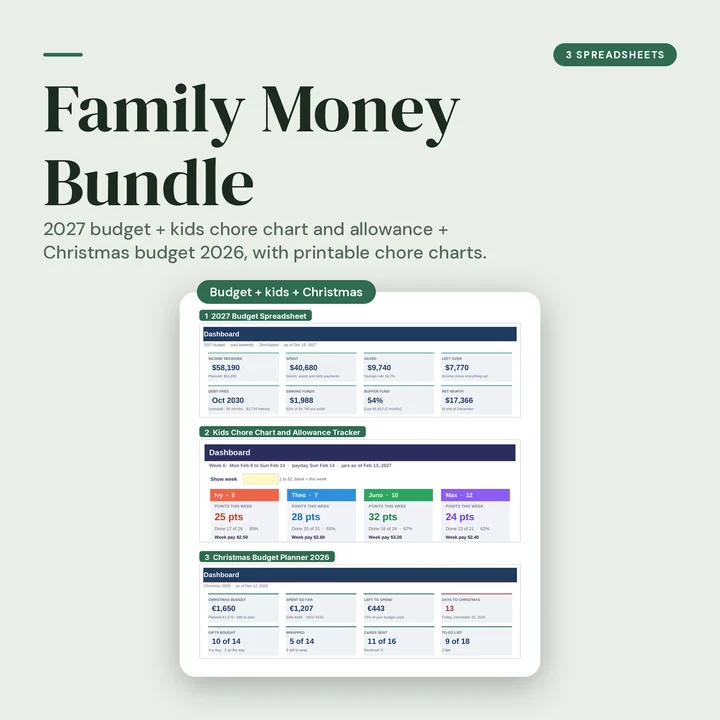 Family Money BundleThe 2027 Budget, the Kids Chore Chart & Allowance Tracker and the Christmas Planner together.€24.99
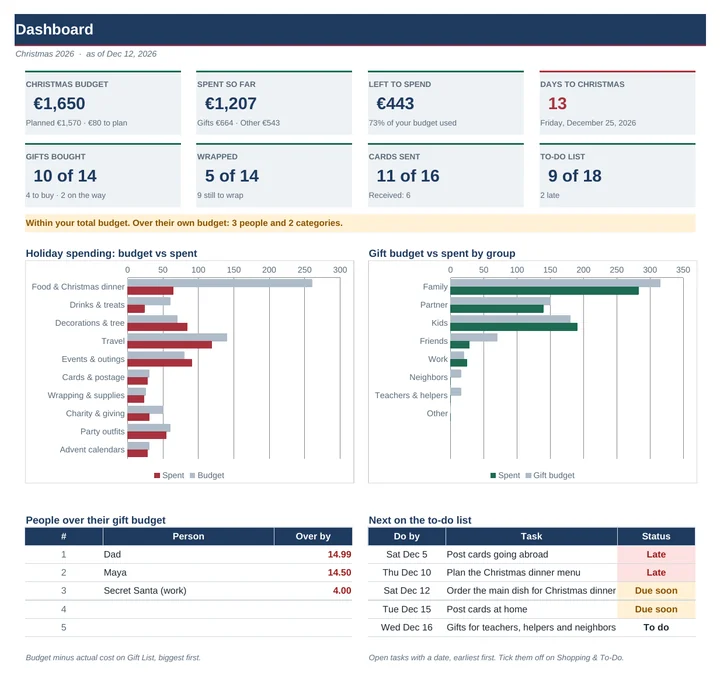 Christmas Budget & Gift Planner 2026A budget for every person on your list, so December doesn't arrive as a surprise in January.€8.99