Money guide · 5 min read · updated 2026-11-10
Wedding Budget Breakdown: How Much a Wedding Costs and Where the Money Goes
The national average is a useful reference, but your budget should start from what you can actually pay. Here’s how to turn one total into category limits, a per-guest number and a payment calendar.
How much does a wedding cost?
According to The Knot 2026 Real Weddings Study, which surveyed 10,474 US couples married in 2025, the overall average wedding cost was $34,200. The Knot notes its state and city figures cover the ceremony and reception and don’t include the engagement ring.
The same study puts the average cost per guest at $292 and the average guest count at 117. Guest count moves the total a lot. The Knot reports these averages by size:
| Guest count | Average cost (The Knot 2026 study) |
|---|---|
| 1–50 guests | $17,100 |
| 51–100 guests | $27,200 |
| Over 100 guests | $43,300 |
An average is pulled up by a smaller number of very expensive weddings, so treat it as context rather than a target. Plenty of couples spend far less. The useful question isn’t what other people spend. It’s what you can pay without debt you’ll resent.
Set the total before you split it
Work out the total from three numbers:
- What you already have saved for the wedding.
- What you can save each month between now and the final vendor payments.
- What family members have actually offered, in writing or at least in a clear conversation.
Add them up and that’s your ceiling. Then pick a guest count, because it drives catering, rentals, invitations and often the venue size.
Who pays: tracking contributions
Families help in different ways. Some give a fixed sum, some cover a specific vendor, some pay a bill directly. All three work, but they need to be written down.
For every contributor, note the amount, whether it’s cash to you or paid straight to a vendor, and when it will arrive. A pledge that lands after the venue balance is due doesn’t help with the venue. Talk early about whether a contribution comes with expectations, such as extra guests, so there are no surprises when invitations go out.
A starting split by category
Once you have a total, give every category a limit. The percentages below are a common starting point, not a rule. Couples who care most about food or photos should move money toward those and take it from somewhere else.
Two things are worth doing from the start. Put venue and catering together, because they’re often one contract and almost always the largest cost. And set aside a buffer for overruns. Something in the range of 5% to 10% is a sensible rule of thumb. Late additions, service charges, tips, alterations and extra rentals add up.
Worked example: $25,000 for 100 guests
Here’s how a couple with a $25,000 ceiling and 100 guests might set their first draft. The couple is putting in $17,000, one set of parents $5,000 and the other $3,000.
| Category | Share | Budget | Per guest |
|---|---|---|---|
| Venue, catering and bar | 45% | $11,250 | $112.50 |
| Photography and video | 12% | $3,000 | $30.00 |
| Attire and beauty | 8% | $2,000 | $20.00 |
| Flowers and decor | 8% | $2,000 | $20.00 |
| Music and entertainment | 6% | $1,500 | $15.00 |
| Cake and desserts | 3% | $750 | $7.50 |
| Wedding rings | 3% | $750 | $7.50 |
| Invitations and stationery | 2% | $500 | $5.00 |
| Transportation | 2% | $500 | $5.00 |
| Favors and gifts | 2% | $500 | $5.00 |
| Officiant and ceremony fees | 1% | $250 | $2.50 |
| Buffer for overruns | 8% | $2,000 | $20.00 |
| Total | 100% | $25,000 | $250.00 |
If the couple has 14 months to go, their own $17,000 works out to about $1,214.29 a month, less whatever they’ve already saved.
Cost per guest, and why it can mislead
Total budget divided by guests gives a quick per-guest figure: $25,000 ÷ 100 = $250 in the example. It’s handy for comparing options, but not every cost scales with headcount. A photographer or DJ costs the same for 60 people or 160.
So split the big contract into a fixed part and a per-head part. Suppose the $11,250 venue and catering line is a $3,250 venue fee plus $80 a person for food (The Knot’s 2026 study gives $80 as the average catering cost per person) for 100 guests: $3,250 + $8,000 = $11,250.
Now add 20 guests. Catering rises by 20 × $80 = $1,600, so the total becomes $26,600, assuming nothing else changes. The cost per guest drops to about $221.67, yet the wedding costs more. When you’re deciding on the guest list, look at the extra cost of each added guest, not the average.
Deposits and payment schedules
Most vendors take a deposit when you book and the rest later, sometimes in two or three stages. Terms vary by vendor and contract, so read each one for the amounts, the due dates and what happens to the deposit if you cancel or change the date.
The money problem with weddings is often timing more than total. Several deposits can fall in the same month a year out, and several balances land in the final weeks. Laying them out on a calendar shows whether your savings and the family contributions will arrive in time. Here’s an example schedule for the four biggest vendors in the plan above, using example terms:
| Vendor | Total | Deposit (when booked) | Second payment | Final balance |
|---|---|---|---|---|
| Venue and catering | $11,250 | $3,000 (12 months out) | $4,000 (6 months out) | $4,250 (2 weeks before) |
| Photographer | $3,000 | $1,000 (11 months out) | — | $2,000 (1 month before) |
| Florist | $2,000 | $500 (6 months out) | — | $1,500 (2 weeks before) |
| DJ | $1,500 | $500 (9 months out) | — | $1,000 (week of) |
| Total | $17,750 | $5,000 | $4,000 | $8,750 |
Half the money for these four vendors, $8,750, is due in the last month. That’s the stretch to plan for. If a parent’s contribution is meant to cover the venue balance, make sure it arrives before that date.
Keeping the budget honest
- Record the quote, then the contract. The signed amount, with service charges and tax, is the real number.
- Update after every payment. Track paid and still owed for each vendor, not just the total.
- Move money, don’t add it. If flowers run over, take it from another category or the buffer, and write down where it came from.
- Count tips and alterations. They’re easy to forget because no one sends an invoice.
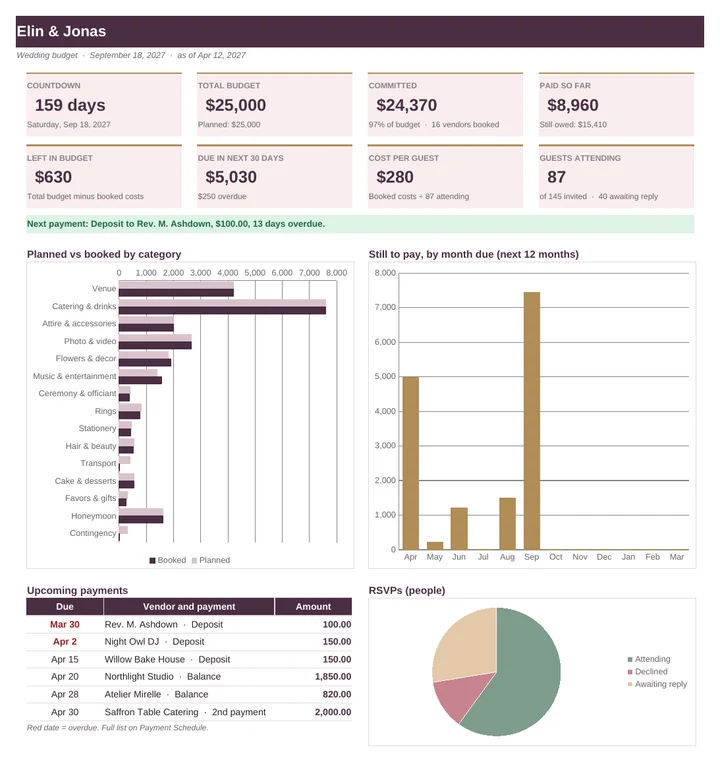
Our wedding budget planner spreadsheet follows this structure. It has 15 budget categories with a typical-percentage guide, a vendor list with deposits, second payments, balances and due dates, a payment schedule, a guest list for up to 300 with RSVPs, cost per guest and a contributions tracker.
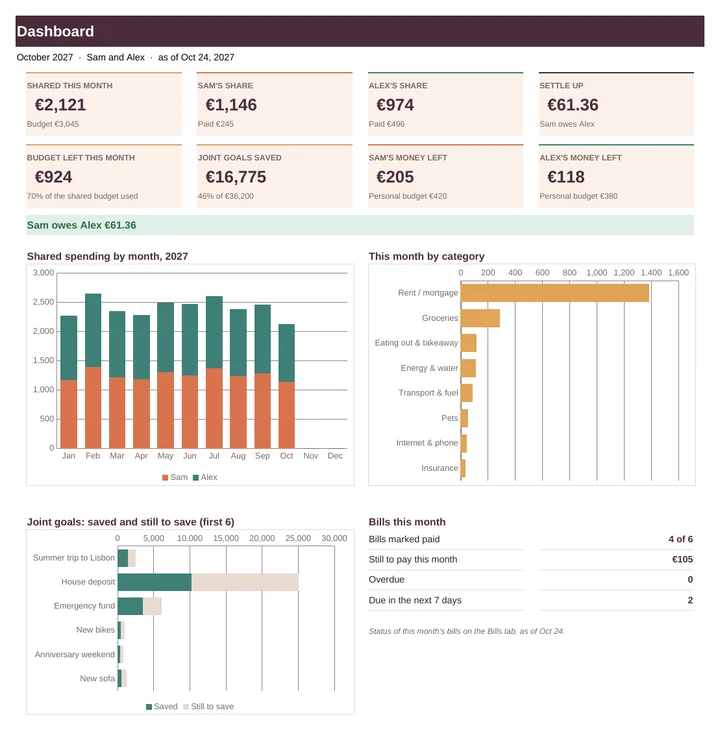
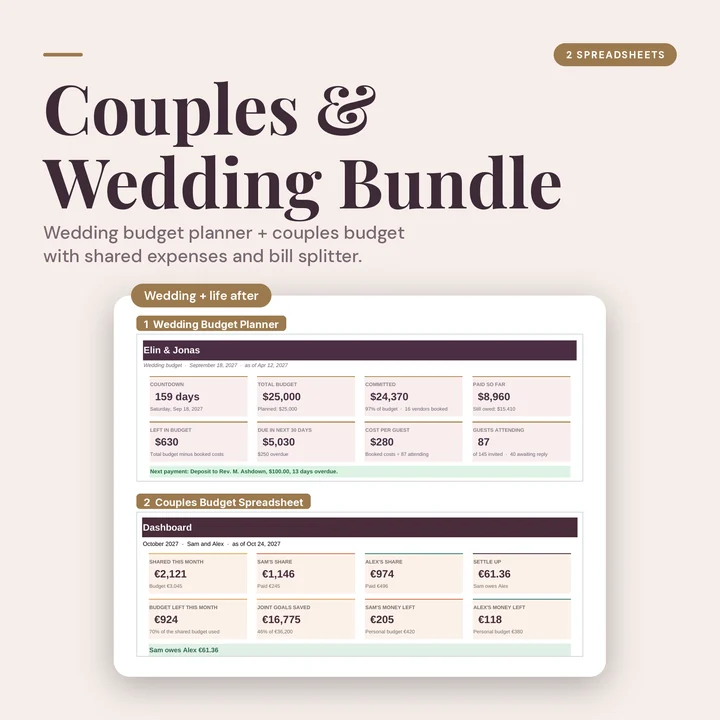
After the wedding, the shared money questions don’t stop. Our couples budget spreadsheet and the guide on how to split bills as a couple pick up from there, and the wedding and couples budget bundle includes both spreadsheets.
Whatever number you settle on, write it down, split it, and check every new quote against its category. If you want the categories, vendor payments and guest list in one file, the wedding budget planner is set up for exactly that.
Sources
Spreadsheets for this
 Wedding Budget PlannerBudget, vendors, payment due dates and the guest list, all in one place.€12.99
 Couples Budget & Bill SplitterOne shared budget for two. Log shared costs and it tells you who owes whom.€11.99
 Couples & Wedding BundleThe Wedding Budget Planner for the big day and the Couples Budget for after it.€19.99