Money guide · 6 min read · updated 2026-11-10
How to split bills as a couple
There is no single fair way to share household costs. There are four common methods, and the right one depends on how close your incomes are and how much separation you both want.
Start with what counts as a shared bill
Before you argue about percentages, agree on the list. Most couples put these in the shared pile: rent or mortgage, utilities, internet, groceries, home insurance, household supplies and any streaming services you both use. Things that are usually personal: your own phone, clothes, hobbies, gym membership, lunches at work and gifts for your own family.
The grey areas cause most of the friction. Eating out together, a car only one of you drives, a pet, or a holiday you both take. Decide on these out loud once, write the decision down, and you will not have to relitigate them every month.
Once you have the list, total it. That monthly number is what you are actually splitting.
Method 1: Split everything 50/50
Each of you pays half of every shared bill. It is easy to understand and easy to track, and it feels fair when you earn roughly the same.
- Works well when: your take-home pay is similar, or you are early in the relationship and keeping finances mostly separate.
- Watch out for: a big pay gap. Half the rent can be a comfortable slice of one paycheck and a painful slice of the other. The lower earner may end up with almost no money of their own, or the couple ends up choosing a cheaper flat than the higher earner would like.
Method 2: Split in proportion to income
Each person pays the same percentage of their income toward shared costs, so the higher earner pays more in dollars. This is what most people mean by splitting expenses based on income.
The formula is simple: your share = your take-home pay ÷ combined take-home pay. Use take-home pay (after tax and payroll deductions) rather than gross salary, because that is the money that actually arrives in your accounts.
- Works well when: one of you earns noticeably more, and you want both people to have a similar amount of breathing room afterwards.
- Watch out for: income that changes. Recalculate when either of you gets a raise, changes jobs or has a lean month. If one of you is self-employed, use a typical month or a recent average rather than a one-off high.
Method 3: Pool everything in a joint account
Both paychecks go into one joint account. All bills and savings come out of it, and each person may get a fixed amount of personal spending money.
- Works well when: you are married or long-term partners, share big goals, and genuinely think of the money as “ours”.
- Watch out for: different spending styles. Without personal allowances, every purchase becomes visible and potentially up for debate. It is also harder to untangle if things change.
Method 4: Yours, mine and ours
A hybrid. You each keep a personal account, and you both pay into a shared account that covers the shared bills. The contributions can be 50/50 or proportional to income. Whatever is left in your own account is yours to spend without discussion.
- Works well when: you want to share household costs fairly but keep some independence. It is probably the most common setup for couples who live together.
- Watch out for: the shared account running short. Build in a small cushion, and agree what happens when a bill goes up.
Worked example: 50/50 vs proportional
Alex takes home $3,200 a month and Sam takes home $2,100. Their shared costs come to $2,150 a month.
Combined take-home pay is $3,200 + $2,100 = $5,300. Alex earns 3,200 ÷ 5,300 = 60.38% of it, and Sam earns 2,100 ÷ 5,300 = 39.62%.
| Alex | Sam | Total | |
|---|---|---|---|
| Take-home pay | $3,200.00 | $2,100.00 | $5,300.00 |
| Share of income | 60.38% | 39.62% | 100% |
| Pays (proportional) | $1,298.11 | $851.89 | $2,150.00 |
| Left over (proportional) | $1,901.89 | $1,248.11 | $3,150.00 |
| Pays (50/50) | $1,075.00 | $1,075.00 | $2,150.00 |
| Left over (50/50) | $2,125.00 | $1,025.00 | $3,150.00 |
Under the proportional split, both of them spend 40.57% of their take-home pay on shared costs (1,298.11 ÷ 3,200 and 851.89 ÷ 2,100). Under 50/50, Alex spends about 33.6% and Sam about 51.2%. Sam would be left with $1,025 for everything personal, while Alex keeps more than twice that.
Notice that the total left over is $3,150 either way. The method doesn’t change how much money the household has; it only changes who carries the weight.
Some couples land in between, for example agreeing that Alex pays $1,200 and Sam pays $950. That is fine. The point of running the numbers is to make the choice on purpose rather than by default.
Handling unequal personal spending
Splitting bills fairly is only half the story. The other half is what happens to the money left over.
- Keep personal money personal. If one of you spends on gadgets and the other saves, that is not a shared-bill problem as long as the shared account is covered. Agreeing not to comment on each other’s personal spending removes a lot of tension.
- Set a “check with me” limit. Many couples agree that any single purchase over a set amount, say $200, gets mentioned first, even from personal money, if it affects shared plans.
- Treat shared fun as a shared bill. If you eat out together every week, give it a line in the shared budget instead of taking turns paying and keeping mental score.
- Agree on savings separately. Decide whether joint goals (a deposit, a wedding, a holiday) come out of the shared pot or from each person’s leftover money. If you are saving for a wedding, the wedding budget breakdown guide covers how to plan the costs.
Settling up once a month
Even with a shared account, someone will pay for groceries on their personal card or cover a bill that was supposed to be split. Tracking every one of these in real time is tiring. A monthly settle-up is easier:
- Through the month, log every shared expense with the date, amount and who paid.
- At month end, add up what each of you actually paid toward shared costs.
- Compare it with what each of you should have paid under your chosen split.
- The person who paid less transfers the difference to the other. One transfer, done.
For example, if Alex should have paid $1,298.11 but actually paid $1,150.00 because Sam covered a few grocery runs, Alex owes Sam $148.11 for that month.
Pick a fixed day for this, such as the first Sunday of the month, and keep it short. It is an admin task, not a review of each other’s choices.
Revisit the split
Any of these methods can be fair. What matters is that both of you chose it, and that you check it when life changes: a new job, a move, a baby, one partner going back to study. A quick review once or twice a year keeps it from drifting into something that no longer suits either of you.
This guide is general information, not financial advice. Your own situation may call for a different approach.
Track it in a spreadsheet
You can do all of this with a notebook and a calculator, but a spreadsheet saves the repeated maths. If you’d rather not build one yourself, our Couples Budget & Bill Splitter works out the income-based percentages, logs who paid for what and calculates the monthly settle-up for you. If you are just starting to budget together, the simple monthly budget is a lighter one-page option, and you can come back to the bill splitter once you want the split tracked.
Spreadsheets for this
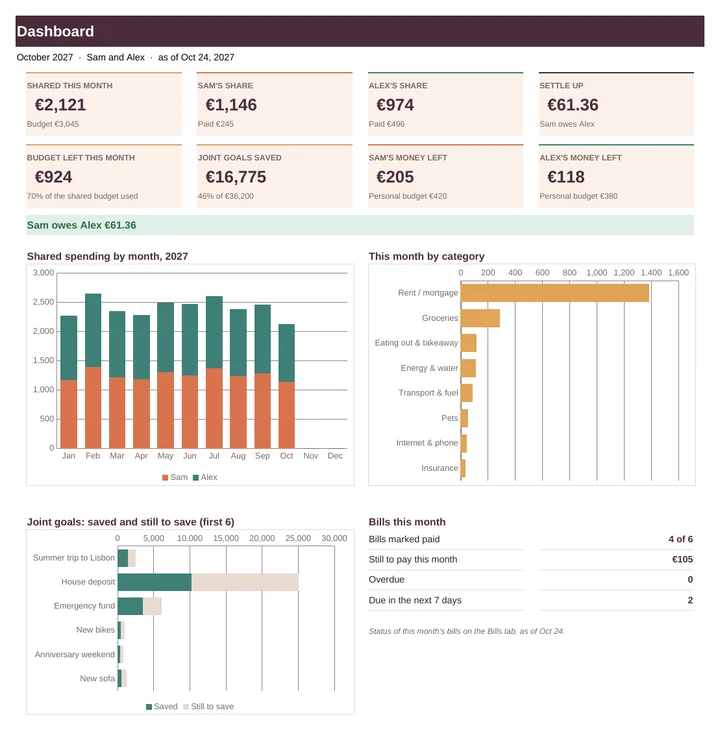 Couples Budget & Bill SplitterOne shared budget for two. Log shared costs and it tells you who owes whom.€11.99
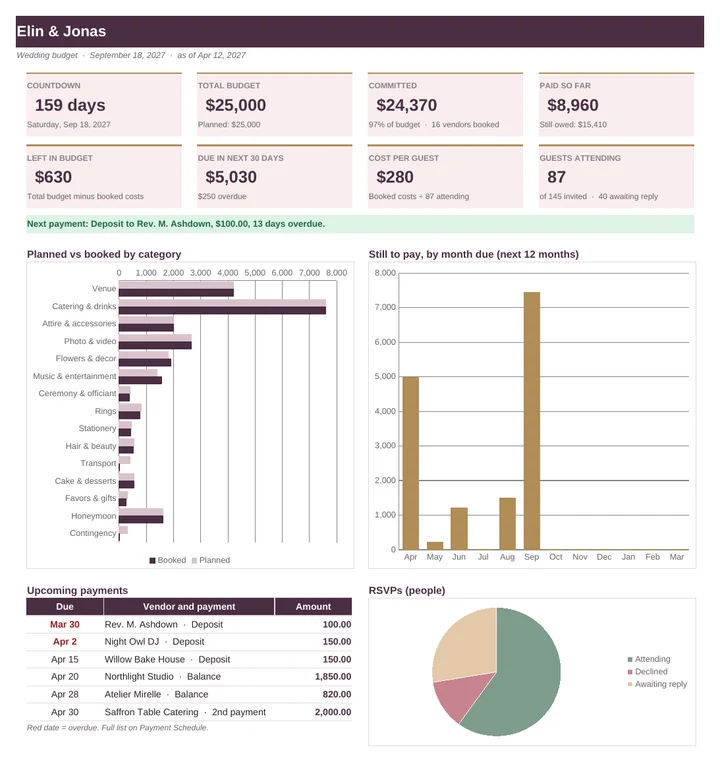 Wedding Budget PlannerBudget, vendors, payment due dates and the guest list, all in one place.€12.99
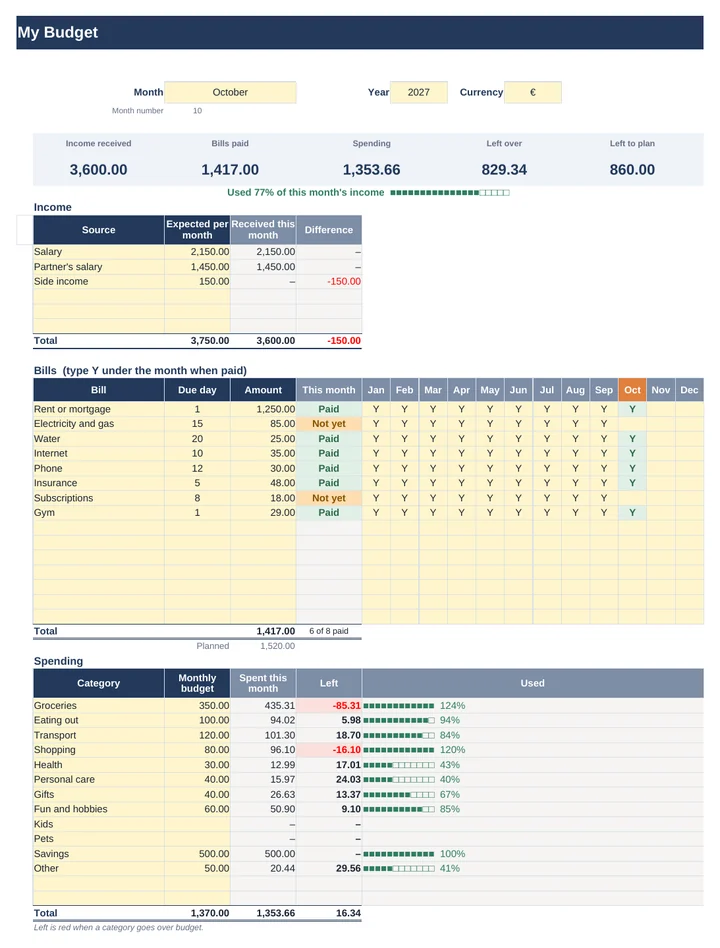 Simple Monthly Budget PlannerIncome, bills, spending and what’s left on one page. Pick a month and every number follows.€7.99