Money guide · 5 min read · updated 2026-11-10
How to budget with irregular income
When your pay changes every month, a normal monthly budget breaks the first time a lean month arrives. The fix is to budget from your worst month, not your average, and let the good months build a buffer.
Why the usual budget doesn’t work
A standard budget assumes a fixed paycheck: money comes in, you assign it, repeat. Freelancers, contractors, commission-based salespeople, gig workers, seasonal workers and small business owners don’t get that. One month brings in twice what the next does.
The common mistake is budgeting from your average income. On paper the average covers everything. In practice, a run of below-average months leaves you short on rent, and a good month gets spent because it feels like extra. The method below avoids both.
Step 1: Find your baseline
Look back over the last 6 to 12 months and find your lowest month of take-home income. If you are self-employed, use the figure after setting aside money for tax (step 2). That lowest month is your baseline.
Your baseline budget is the spending plan you can afford in that worst month. If your essentials don’t fit inside it, you know now, while you can still adjust, rather than in the middle of a bad month.
If you have no history yet, make a conservative estimate. It is safer to start low and raise the baseline later than the other way round.
Step 2: Set aside tax first (if you’re self-employed)
Employees have tax withheld from each paycheck. Self-employed people usually don’t, so the tax on every payment you receive is money you will owe later. In the US, self-employed people pay self-employment tax of 15.3% (Social Security and Medicare) on top of income tax, and the IRS generally expects estimated tax payments during the year if you expect to owe $1,000 or more when you file.
The simplest habit: every time a payment lands, move a fixed percentage into a separate tax savings account before you do anything else. Treat that money as already gone. The right percentage depends on your income, deductions and where you live; our guide to how much to set aside for quarterly taxes walks through estimating it.
Step 3: Write a priority-ordered spending list
Instead of a fixed list of categories, rank your spending from most to least essential. When money arrives, you fund the list from the top down and stop when the money runs out.
- Housing (rent or mortgage) and utilities
- Groceries and essential transport
- Insurance and minimum debt payments
- Phone, internet and work tools you need to earn
- Contributions to sinking funds for known yearly costs
- Extra debt payments and savings goals
- Eating out, entertainment and other flexible spending
Everything down to the line where your baseline runs out is your baseline budget. Everything below that line only happens in months when there is money for it, or once your buffer is full.
Step 4: Build a buffer with every surplus
Any month you earn more than your baseline, the difference goes into a separate buffer fund (sometimes called an income-smoothing fund). In a lean month, you top up from the buffer to reach your baseline. Over time, the buffer absorbs the swings so your spending doesn’t have to.
This is different from an emergency fund. The buffer handles the normal ups and downs of your income; an emergency fund is for the unexpected, such as a medical bill or losing a major client. Many people use one account for both while building up, then separate them later.
A common target for the buffer is one to three months of your baseline budget. Choose based on how long your slowest stretches usually last.
Worked example: six months of freelance income
Jordan is a freelance designer. For this example, Jordan sets aside 25% of every payment for tax (an illustrative figure, not a recommendation). Here are six months:
| Month | Income received | Tax set aside (25%) | After tax | Above baseline → buffer | Buffer balance |
|---|---|---|---|---|---|
| January | $4,000 | $1,000 | $3,000 | $600 | $600 |
| February | $3,200 | $800 | $2,400 | $0 | $600 |
| March | $6,000 | $1,500 | $4,500 | $2,100 | $2,700 |
| April | $3,600 | $900 | $2,700 | $300 | $3,000 |
| May | $6,800 | $1,700 | $5,100 | $2,700 | $5,700 |
| June | $4,000 | $1,000 | $3,000 | $600 | $6,300 |
| Total | $27,600 | $6,900 | $20,700 | $6,300 |
Jordan’s lowest after-tax month was February at $2,400, so the baseline is $2,400. Every month, Jordan lives on $2,400, which is $14,400 over six months. The other $6,300 of after-tax income went to the buffer. The check: $14,400 + $6,300 = $20,700, the total after tax.
If Jordan had budgeted from the average instead ($20,700 ÷ 6 = $3,450 a month), four of the six months would have come up short: January by $450, February by $1,050, April by $750 and June by $450.
After six months, the buffer holds $6,300, about 2.6 months of the $2,400 baseline. That opens up the next step.
Step 5: Pay yourself a fixed salary
Once the buffer is comfortable, you can stop thinking month to month. All income goes into a holding account (with tax taken off first), and on the same day each month you transfer yourself a fixed “salary” into your everyday account. You budget that salary like a regular paycheck.
The salary can be your baseline, or a little higher if your records support it. Jordan, for example, might move to a $2,800 salary while keeping the buffer above $5,000. If the holding account shrinks for several months in a row, lower the salary. If it keeps growing past your target, raise it or send the surplus to savings, debt or the flexible items at the bottom of your list.
Habits that keep it working
- Separate accounts help. Keep tax money, the buffer and everyday spending in different places, so a good month doesn’t blur into spending money.
- Review every quarter. Look at your last few months, check whether the baseline still reflects reality, and update it.
- Plan for annual costs. Irregular income makes irregular bills harder. Sinking funds turn them into small monthly amounts that sit in your baseline.
- Don’t raise spending after one great month. Wait until a higher income level has held for a while.
This guide is general information, not financial or tax advice. Tax rules depend on your circumstances; check with the IRS or a tax professional for your own situation.
Tools to make it easier
You can run this system on paper, but the baseline, buffer and tax set-aside are easier to keep straight in a spreadsheet. If you’d rather not build it yourself, our 2027 Budget Planner has an irregular-income mode that sets your baseline from your lowest month, sets a percentage aside for tax and tracks a buffer fund alongside sinking funds. Self-employed readers may also want the quarterly tax tracker to plan estimated payments, and the sinking funds tracker for yearly bills. Start with the budget planner and your last six months of income, and you will have a baseline in one sitting.
Sources
Spreadsheets for this
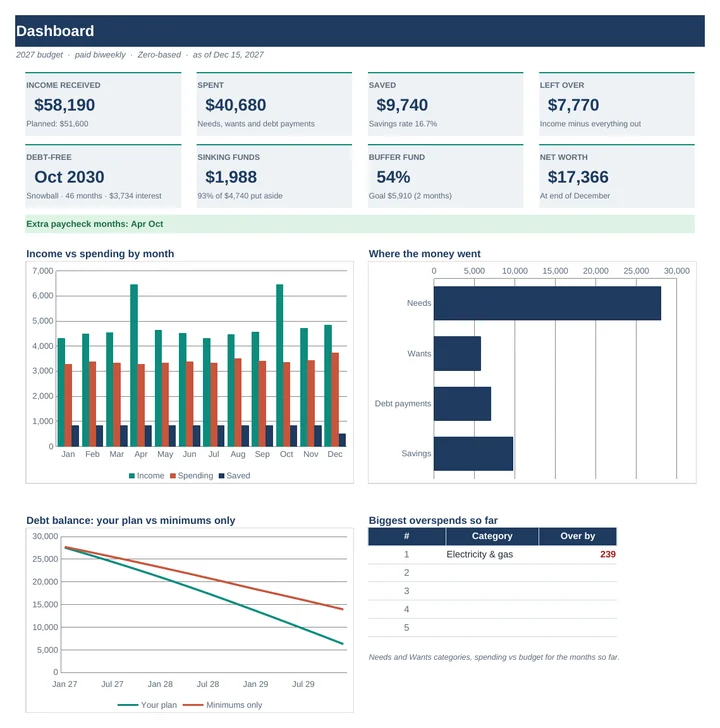 2027 Budget PlannerPlan the year one paycheck at a time, even when your income changes month to month.€15.99
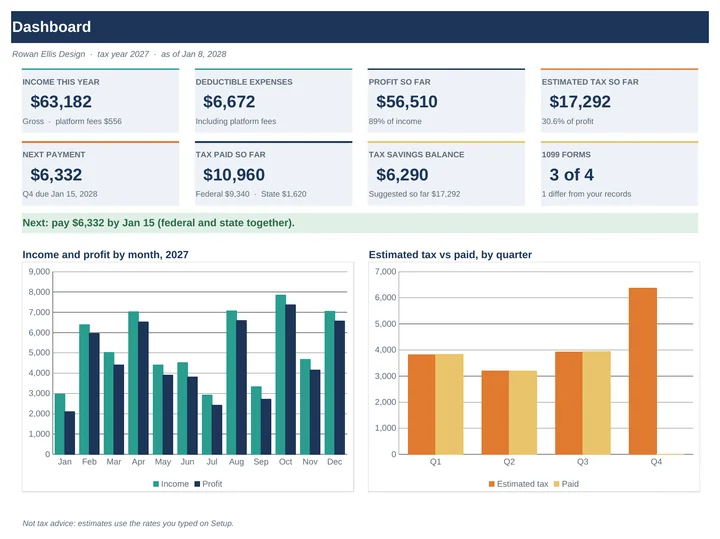 Freelancer Quarterly Tax & 1099 TrackerWhat to set aside, what to pay by each due date, and a check of every 1099.€11.99
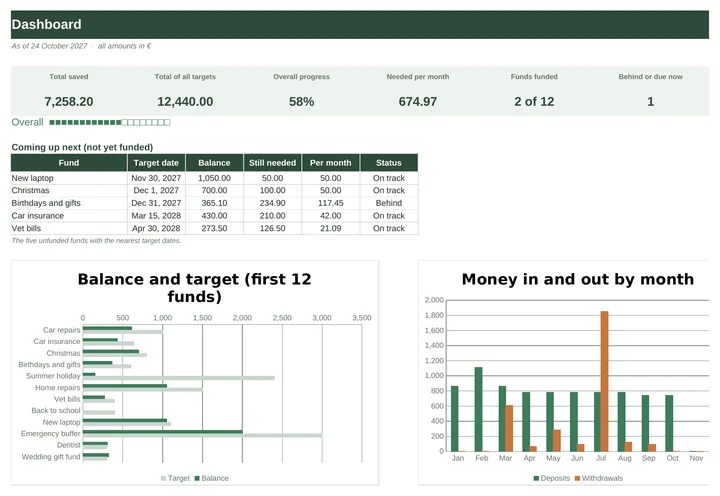 Sinking Funds TrackerUp to 30 funds with a target and a date. It tells you what to put aside each month.€8.99