Money guide · 6 min read · updated 2026-11-10
How to Track Rental Property Income and Expenses for Schedule E
If you own a rental, the easiest tax season starts with how you record each payment during the year. Set up your records to match Schedule E, and filing turns into copying totals.
This is general information, not tax advice. Rental tax rules have many exceptions. Check with a tax professional and the IRS publications linked below before filing.
Start with the form you’ll fill in
Most individual landlords report rental income and expenses on Schedule E (Form 1040), Part I. The form has columns for up to three properties per page. For each property it asks for the address, the property type (single family, multi-family, vacation or short-term rental, commercial and so on) and the number of fair rental days and personal use days.
Then come the money lines. On the current Schedule E they are:
| Line | What goes there |
|---|---|
| 3 | Rents received |
| 4 | Royalties received |
| 5 | Advertising |
| 6 | Auto and travel |
| 7 | Cleaning and maintenance |
| 8 | Commissions |
| 9 | Insurance |
| 10 | Legal and other professional fees |
| 11 | Management fees |
| 12 | Mortgage interest paid to banks, etc. |
| 13 | Other interest |
| 14 | Repairs |
| 15 | Supplies |
| 16 | Taxes |
| 17 | Utilities |
| 18 | Depreciation expense or depletion |
| 19 | Other (list) |
| 20 | Total expenses (lines 5 through 19) |
The practical lesson: give every expense you record a category that matches one of those lines. If your ledger says “Home Depot, $86” with no category, you’ll be sorting receipts in March. If it says “Supplies, Unit B, $86,” the total is already done.
Track each property separately
Schedule E wants figures per property, so your records should keep them apart from day one. Tag every income and expense entry with the property it belongs to. A duplex counts as one property with two units, but tracking by unit as well shows you which side earns its keep.
Expenses that cover several properties, like one insurance policy or one accountant’s bill, need to be split in a reasonable way. Write down how you split them so you can apply the same method each year.
What counts as rental income
Rent is the obvious part, but IRS Publication 527 adds a few that catch people out:
- Advance rent. Rent received before the period it covers goes in income in the year you receive it, whatever period it covers. January rent paid in December is income for the December year.
- Security deposits. Don’t include a deposit in income when you receive it if you plan to return it. If you keep part of it because the tenant didn’t live up to the lease, include that amount in the year you keep it.
- “Deposits” used as last month’s rent. If a so-called deposit is meant to be the final rent payment, it’s advance rent and counts as income when received.
- Expenses paid by the tenant. If a tenant pays one of your bills, that payment is rental income. You may also be able to deduct the expense.
Because deposits sit in your account but often aren’t yours, keep them in their own ledger: tenant, amount received, date, and what was returned or kept at move-out.
Repairs versus improvements
This is the distinction that matters most for your tax bill, and the one most worth recording carefully.
A repair keeps the property in its normal working condition. Publication 527 says repair and maintenance costs can generally be deducted in the year paid, as long as you aren’t required to capitalize them.
An improvement has to be capitalized. Pub 527 treats a cost as an improvement if it results in a betterment to the property, restores it (such as replacing a substantial structural part), or adapts it to a new use. Its examples include a new roof, a furnace, storm windows and doors, and kitchen modernization. Capitalized improvements are generally depreciated, and improvements to residential rental property use the same 27.5-year recovery period as the building under the general system.
Pub 527 tells landlords to separate the costs of repairs and improvements and keep accurate records, because you’ll need the improvement costs when you depreciate or sell. A simple way to do that is a separate capital improvements list for each property, with date, description, cost and the date it was placed in service.
Mileage and travel
Trips to collect rent, show a unit, meet a contractor or buy supplies can be deductible as local transportation. Pub 527 notes that driving between your home and the rental is generally nondeductible commuting unless your home is your principal place of business. For 2025 it gives the standard mileage rate as 70 cents a mile.
Car expenses need records that follow the rules in chapter 5 of Publication 463. In practice, keep a log with the date, start and end point, purpose, property and miles for each trip, written at the time rather than rebuilt from memory.
Records to keep
IRS Publication 583 describes supporting documents as sales slips, paid bills, invoices, receipts, deposit slips and canceled checks. For a rental, that also means leases, deposit receipts, closing statements, insurance declarations, property tax bills and your mortgage interest statement.
How long? Pub 583 says to keep records that support income or deductions until the period of limitations for that return runs out, generally three years, with longer periods in some cases. Records relating to the property itself, such as purchase documents and improvement receipts, should be kept until the period of limitations expires for the year you dispose of the property.
Worked example: one duplex for a year
Here’s a sample year for a duplex, using 2025 figures and made-up numbers. Unit A rents for $1,450 a month and is occupied all year. Unit B rents for $1,350 and sat empty for one month between tenants. When the old Unit B tenant left, the owner kept $200 of their deposit for damage and returned the rest. The owner also replaced the furnace for $5,400.
| Income | Calculation | Amount |
|---|---|---|
| Unit A rent | $1,450 × 12 | $17,400.00 |
| Unit B rent | $1,350 × 11 | $14,850.00 |
| Deposit kept for damage | $200.00 | |
| Total rental income | $32,450.00 |
| Schedule E line | Notes | Amount |
|---|---|---|
| 5 Advertising | Listing for Unit B | $120.00 |
| 6 Auto and travel | 312 logged miles × $0.70 | $218.40 |
| 7 Cleaning and maintenance | Turnover clean, lawn care | $1,140.00 |
| 9 Insurance | Landlord policy | $1,860.00 |
| 10 Legal and professional fees | Tax preparer’s share | $450.00 |
| 12 Mortgage interest | From lender statement | $9,240.00 |
| 14 Repairs | Leaking faucet, broken window, dryer vent | $1,385.00 |
| 15 Supplies | Smoke detector batteries, filters, locks | $260.00 |
| 16 Taxes | Property tax | $4,120.00 |
| 17 Utilities | Water, sewer, trash (owner-paid) | $1,560.00 |
| Total before depreciation | $20,353.40 |
Net before depreciation: $32,450.00 − $20,353.40 = $12,096.60.
Notice what’s missing from the repairs line: the $5,400 furnace. It goes on the capital improvements list instead and is recovered through depreciation over time, along with the building itself. Line 18 would then be filled in from your depreciation records (Form 4562 in the first year), which is why the example stops at net before depreciation.
A setup that makes filing quick
- A rent roll showing each unit, tenant, rent due and rent received each month.
- An income ledger and an expense ledger, every row tagged with property and Schedule E line.
- A separate list for capital improvements.
- A deposit ledger.
- A mileage log.
Our rental property spreadsheet is laid out this way. It handles 1 to 25 properties, sorts income and expenses by property and Schedule E line, keeps repairs apart from capital improvements, and prints a Schedule E summary at year end. If you’d like the same structure for a side business too, the landlord spreadsheet bundle pairs it with our small business bookkeeping spreadsheet.
However you track it, the goal is the same: by December, every number Schedule E asks for should already be totaled. If you’d rather not build the ledgers yourself, the rental property tracker has them ready to fill in.
Sources
Spreadsheets for this
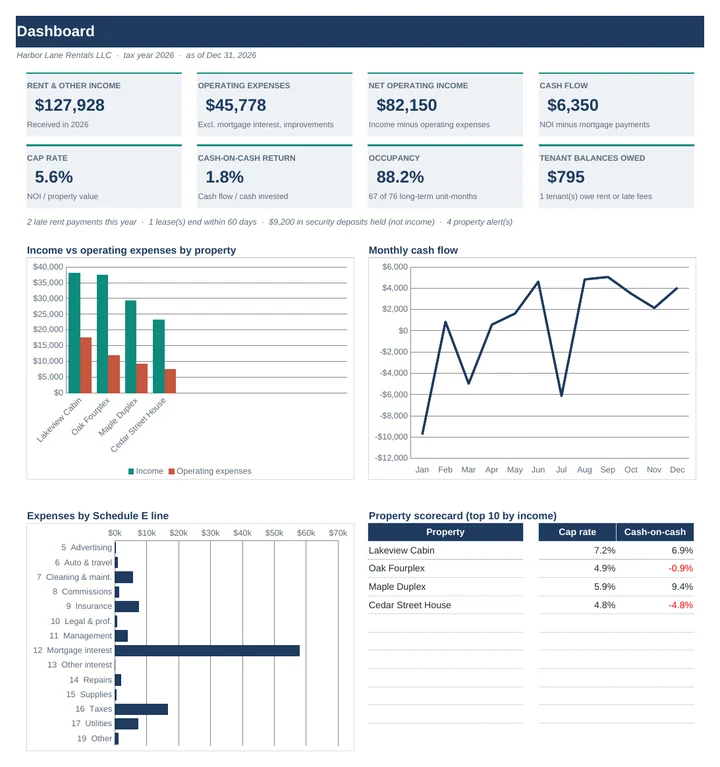 Rental Property TrackerRent, repairs, leases and deposits for one to twenty-five properties.€15.99
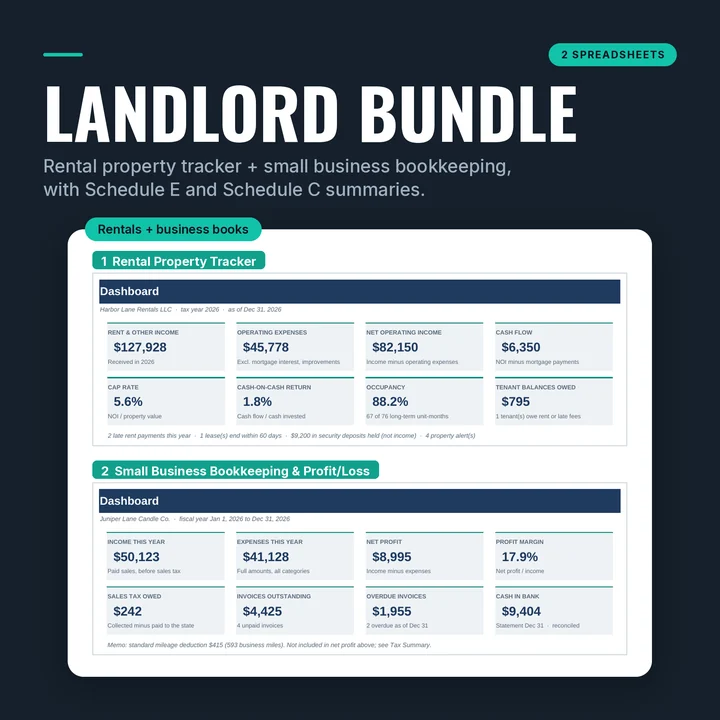 Landlord Bundle: Rental Tracker + BookkeepingThe Rental Property Tracker and the Small Business Bookkeeping workbook in one download.€21.99
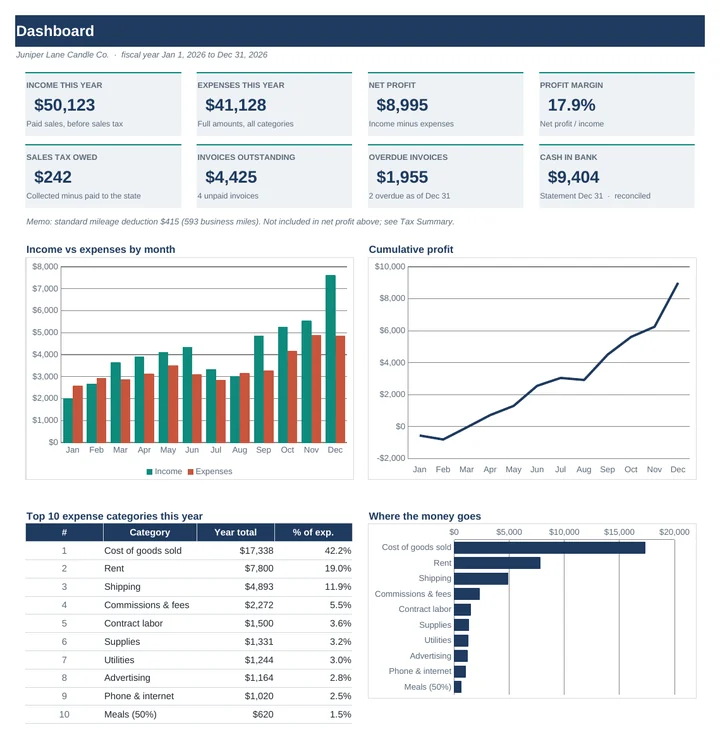 Small Business Bookkeeping & P&LIncome, expenses and invoices in, a monthly profit and loss out. No formulas to write.€11.99