Money guide · 5 min read · updated 2026-11-10
Debt snowball vs avalanche
Both methods pay every minimum and throw any extra money at one debt at a time. The only difference is which debt gets the extra first, and that choice trades interest saved against quick wins.
What the two methods have in common
The snowball and the avalanche are the same plan with a different sort order. In both:
- You list every debt with its balance, interest rate (APR) and minimum payment.
- You decide on one fixed total amount to put toward debt each month: all the minimums plus whatever extra you can manage.
- You pay the minimum on every debt, every month.
- All the extra money goes to one target debt.
- When the target is paid off, its minimum payment does not go back into your spending money. It joins the extra and moves to the next target.
That last step is the rollover, and it is what makes either method work. Your total monthly payment stays the same, but the amount hitting the current target grows each time a debt disappears. It is also why the plan only works if you don’t take on new debt while you pay off the old.
The debt snowball: smallest balance first
With the snowball, you order debts from the smallest balance to the largest and ignore the interest rate. The smallest debt goes first because it can be cleared fastest.
The appeal is psychological. Closing an account in the first few months gives you proof the plan works, and it reduces the number of bills you juggle. For many people, the hard part of paying off debt is not the maths but sticking with it for two or three years.
The debt avalanche: highest interest rate first
With the avalanche, you order debts from the highest APR to the lowest and ignore the balance. Every extra dollar goes where it stops the most interest from building up.
Mathematically, this is the cheaper order. If the highest-rate debt also happens to be large, though, it can take a long time before you close your first account, and that wait is where some people lose momentum.
Worked example: three debts, $150 extra a month
Here is a household with three debts. They pay the minimums ($295 in total) plus $150 extra, so $445 goes to debt every month for the whole plan.
| Debt | Balance | APR | Minimum |
|---|---|---|---|
| Credit card | $3,500 | 24% | $90 |
| Store card | $800 | 18% | $25 |
| Car loan | $6,000 | 7% | $180 |
| Total | $10,300 | $295 |
The orders differ:
- Snowball: store card ($800) → credit card ($3,500) → car loan ($6,000).
- Avalanche: credit card (24%) → store card (18%) → car loan (7%).
The figures below come from a month-by-month simulation: each month, interest is added at APR ÷ 12 on the balance, every minimum is paid, the extra goes to the current target, and a paid-off debt’s minimum rolls over to the next one. Numbers are rounded.
| Snowball | Avalanche | Minimums only | |
|---|---|---|---|
| First debt cleared | Store card, month 5 | Credit card, month 18 | Car loan, month 38 |
| Second debt cleared | Credit card, month 20 | Store card, month 20 | Store card, month 44 |
| Debt-free | Month 27 | Month 27 | Month 76 |
| Total interest paid | About $1,532 | About $1,467 | About $4,325 |
A few things stand out.
The avalanche saved about $65. That is real money, but on $10,300 of debt it is a small gap. Both plans finish in the same month here.
The snowball gave a win thirteen months earlier. The store card was gone by month 5. On the avalanche, the first account closed in month 18. If closing an account early is what keeps you going, $65 is a modest price.
Either method beats paying minimums by a wide margin. Paying only the fixed minimums takes until month 76 and costs about $4,325 in interest, nearly three times as much. That comparison assumes the minimums stay fixed; on real credit cards the minimum usually shrinks as the balance falls, which would make the minimums-only path even longer. The biggest decision is not snowball or avalanche, it is committing to a fixed payment above the minimums and rolling every freed-up minimum forward.
When each method wins
The gap between the two methods depends on how different your interest rates are and how large the high-rate balances are.
- The avalanche wins clearly when you have a large balance at a much higher rate than the rest, for example a big credit card balance at 25%+ next to low-rate loans. The longer that big balance sits at minimum payments, the more the snowball costs you.
- The snowball costs little when your rates are close together, or when your smallest debt is also one of your highest-rate debts. In that case the two orders are nearly or completely the same.
- The snowball may be the better choice if you have tried to pay down debt before and stalled. A plan you follow beats a slightly cheaper plan you abandon.
Some people use a mix: clear one or two tiny balances first for the quick wins, then switch to the avalanche for the rest. That is a perfectly reasonable order as long as the rollover keeps happening.
Practical tips that matter more than the order
- Automate the minimums so a missed payment never adds fees or hurts your credit.
- Make the extra payment right after payday, before the money has a chance to be spent.
- Watch for promotional rates ending. A 0% balance that jumps to a high APR in a few months may need to move up your list.
- Keep a small cash cushion. Without one, a car repair goes straight back onto a card. A few sinking funds for predictable costs help too.
- Use windfalls. A tax refund or bonus can go to the current target as a one-off extra payment.
- Recalculate when something changes, such as a new rate, a larger extra amount or a debt paid off early.
This guide is general information, not financial advice. The example uses simplified, illustrative numbers; your lenders’ terms will differ.
Run your own numbers
The month-by-month simulation is the only way to see what either method really means for your debts, and it is tedious by hand. If you’d rather not build it yourself, our Debt Payoff Tracker takes up to 20 debts and shows the snowball, the avalanche and minimum payments side by side, with your debt-free date, interest saved and a month-by-month payoff plan. If you want debt payoff inside a full household budget, the 2027 Budget Planner includes snowball and avalanche planning, and the simple monthly budget helps you find the extra amount to start with. Once you know your number, plug it into the payoff tracker and log each payment as you go.
Spreadsheets for this
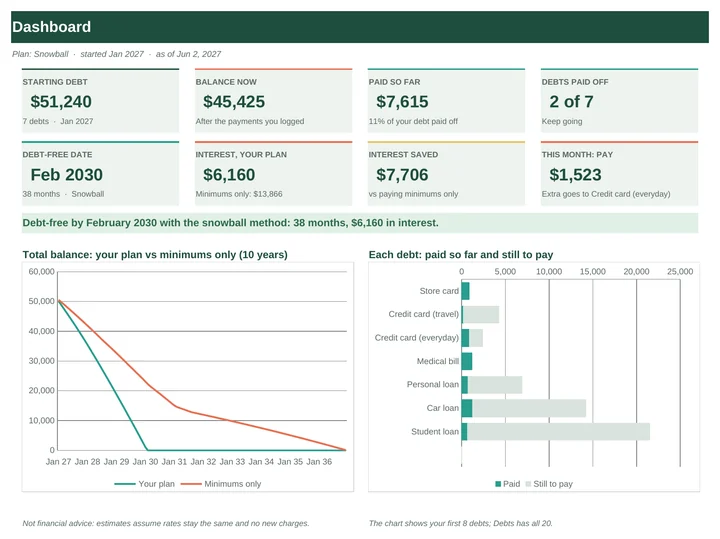 Debt Payoff TrackerSnowball or avalanche for up to 20 debts, with your debt-free date and the interest you save.€7.99
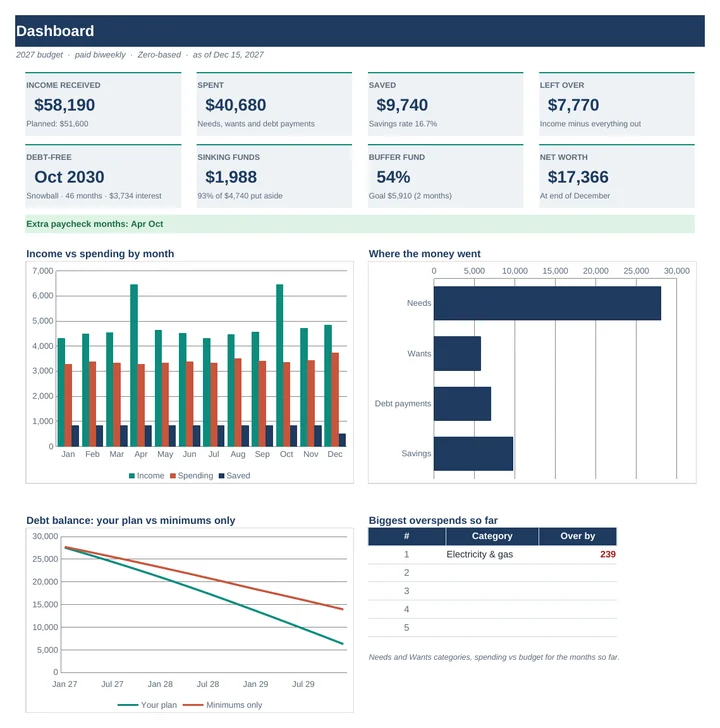 2027 Budget PlannerPlan the year one paycheck at a time, even when your income changes month to month.€15.99
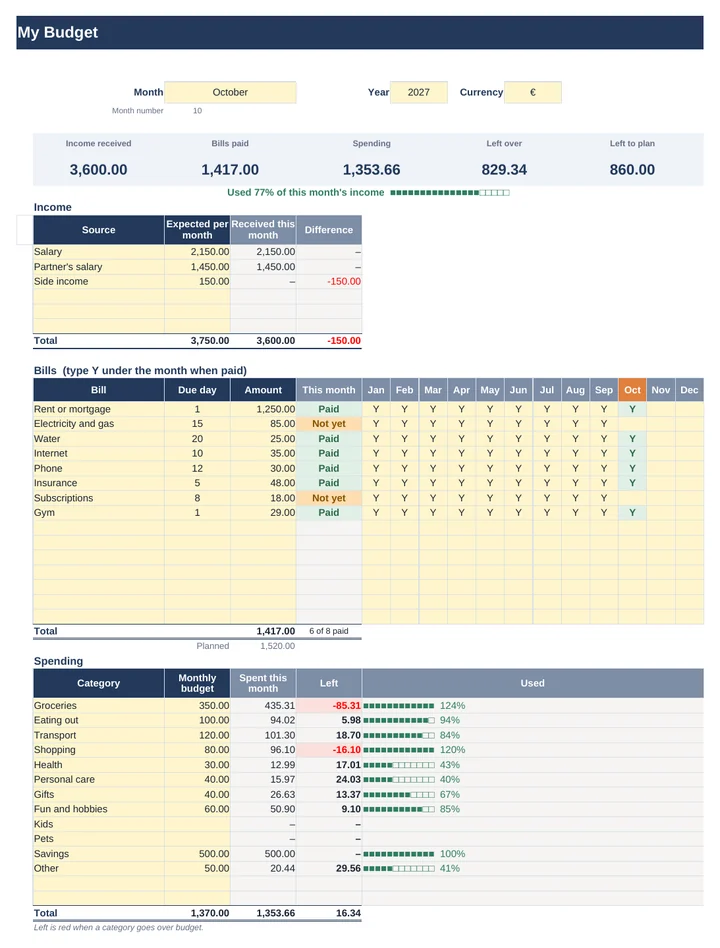 Simple Monthly Budget PlannerIncome, bills, spending and what’s left on one page. Pick a month and every number follows.€7.99