Money guide · 5 min read · updated 2026-11-10
Sinking funds explained
A sinking fund is money you set aside a little at a time for a cost you already know is coming. It turns a large once-a-year bill into a small monthly line in your budget.
What a sinking fund is
Many expenses don’t arrive monthly, but they aren’t surprises either. The car insurance renews every July. Christmas is in December every year. The school asks for supplies and trip money every September. When these land on top of a normal month, they feel like emergencies, and they often end up on a credit card.
A sinking fund fixes that. You pick the expense, estimate the amount, note when it is due, and save a fixed amount each month until then. When the bill arrives, the money is already there.
The name comes from corporate finance, where a company sets money aside over time to repay a bond. At home the idea is the same, just smaller.
Sinking fund vs emergency fund
The two are easy to mix up, and keeping them separate is the point.
| Sinking fund | Emergency fund | |
|---|---|---|
| Purpose | Known, planned costs | Unexpected events |
| Amount | A specific target per fund | A general cushion, often a few months of essentials |
| Timing | A due date you know | Unknown |
| Spending it | Expected: that’s what it’s for | Only when something goes wrong |
Without sinking funds, the emergency fund quietly becomes the account you raid for the car registration and the holiday. Then, when a real emergency comes, it isn’t there. With sinking funds in place, the emergency fund can stay untouched.
Common sinking fund categories
Start by going through last year’s bank statements and listing every cost that didn’t happen monthly. Typical categories include:
- Car insurance and registration, if you pay yearly or every six months
- Car repairs and maintenance: tyres, servicing, brakes
- Christmas and holidays: gifts, food, travel to family
- Birthdays and other gifts through the year, including weddings and baby showers
- Vacations and trips
- School costs: uniforms, supplies, trips, activity fees
- Annual subscriptions: software, memberships, warehouse club, domain names
- Home maintenance: boiler service, gutters, a new appliance
- Medical and dental costs you can predict, such as glasses or a checkup
- Pet costs: vaccinations, grooming, kennels while you’re away
- Big planned purchases: a new laptop, furniture, a phone
You don’t need all of these. Three to six funds covering your largest irregular costs make a noticeable difference. Add more once the habit sticks.
How much to save each month
The formula is simple:
Monthly amount = (target − already saved) ÷ months left
“Months left” is the number of monthly contributions you can make before the money is needed. If a bill is due in July and you start in January, you have six contributions (January to June) if you want the money in hand at the start of July.
Round the result up, to the next cent at least, or to a whole dollar if that’s easier. Rounding down leaves you a few cents or dollars short on the due date. Rounding up leaves a small surplus that rolls into next year.
For costs without a fixed date, like car repairs, pick a yearly amount based on what you spent last year and save one-twelfth of it each month.
Worked example: four funds starting in January
Here is a household setting up four sinking funds at the start of January.
| Fund | Target | Already saved | Needed by | Months left | Exact | Monthly (rounded up) |
|---|---|---|---|---|---|---|
| Car insurance | $780 | $0 | July | 6 | $130.00 | $130.00 |
| Summer vacation | $2,000 | $350 | August | 7 | $235.714… | $235.72 |
| School costs | $450 | $0 | September | 8 | $56.25 | $56.25 |
| Christmas | $900 | $0 | December | 11 | $81.818… | $81.82 |
| Total | $4,130 | $350 | $503.79 |
How the rows work:
- Car insurance: $780 ÷ 6 = $130.00 exactly.
- Summer vacation: ($2,000 − $350) ÷ 7 = $1,650 ÷ 7 = $235.714…, rounded up to $235.72. Seven payments of $235.72 come to $1,650.04, four cents over.
- School costs: $450 ÷ 8 = $56.25 exactly.
- Christmas: $900 ÷ 11 = $81.818…, rounded up to $81.82. Eleven payments come to $900.02.
So this household needs to set aside $503.79 a month from January. That is the number that goes into the monthly budget as a single line.
The total won’t stay the same all year. Once car insurance is paid in July, $130 a month is freed up. You can restart that fund straight away for next year’s renewal, which brings the monthly amount down because you have twelve months instead of six, or move the money to another goal.
If $503.79 is more than your budget allows, you have three levers: lower a target, start earlier next year, or decide that one fund is a “nice to have” and drop it. It’s better to find that out in January than in December.
One account or several?
Both approaches work. The choice is about how you like to see your money.
- One savings account holding all the funds is simpler to set up and means one transfer a month. The catch is that the bank shows one balance, so you need a spreadsheet or list to track how much of it belongs to each fund.
- Several accounts (some banks let you open sub-accounts or “pots” for free) make each fund’s balance visible at a glance. It’s more to manage, and more transfers each month.
A practical middle ground: one account for all sinking funds, kept separate from your emergency fund and everyday account, with a simple tracker showing the split. If you have irregular income, sinking fund contributions belong in your baseline budget; see how to budget with irregular income.
Keeping sinking funds on track
- Automate the monthly transfer on payday so it happens before spending does.
- Check each fund’s status monthly. Is it funded, on track, behind, or due now? Catching a fund that’s behind in April is easier than in November.
- Log withdrawals against the right fund, so you know what each one has left.
- Update targets once a year. Insurance premiums and gift lists tend to creep up.
- Leftovers roll forward. If the vacation cost less than planned, the difference starts next year’s fund.
This guide is general information, not financial advice. Choose targets and timelines that suit your own budget.
Track your funds in one place
A small list works for two or three funds. Once you have more, a spreadsheet does the formula for you. If you’d rather not build one yourself, our Sinking Funds Tracker handles up to 30 funds: enter a target and a date and it works out the monthly amount, rounded up to the cent, shows each fund’s status (Funded, On track, Behind or Due now), keeps a transactions log and gives a yearly overview. If you want sinking funds as part of a full household budget, the 2027 Budget Planner includes them, and for open-ended saving goals there is the savings challenge tracker. Start with your three biggest yearly bills in the tracker and build from there.
Spreadsheets for this
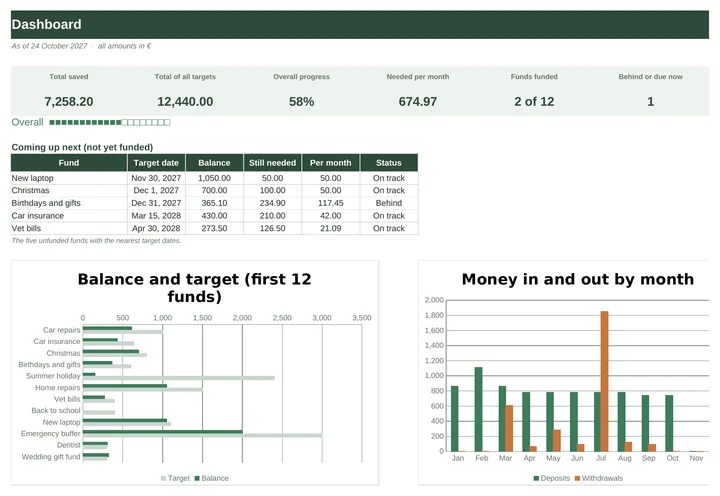 Sinking Funds TrackerUp to 30 funds with a target and a date. It tells you what to put aside each month.€8.99
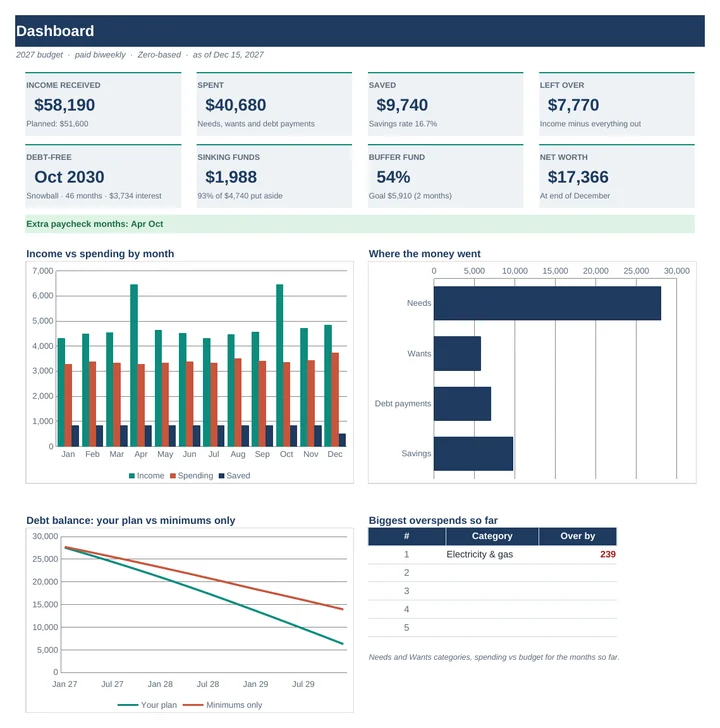 2027 Budget PlannerPlan the year one paycheck at a time, even when your income changes month to month.€15.99
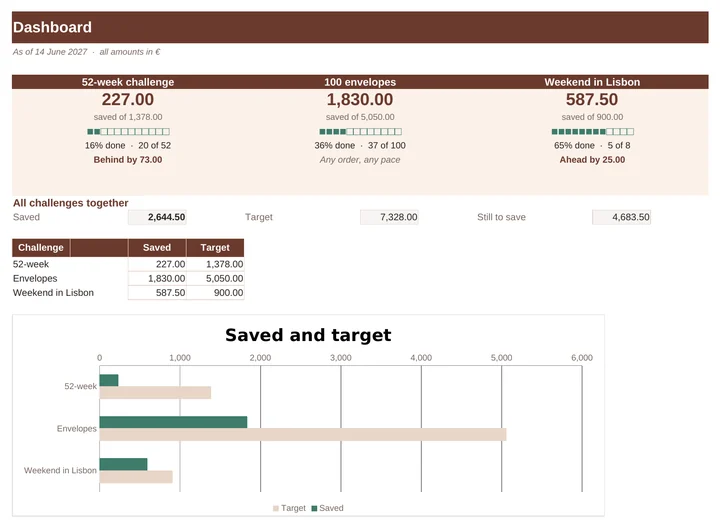 Savings Challenge TrackerThe 52-week challenge, the 100-envelope challenge and a goal of your own, in one file.€7.99